
Unit Price Calculator: Compare Grocery Deals and Save Money
Unit Price Calculator: How to Compare Grocery Deals the Smart Way
Unit Price Calculator: How to Compare Grocery Deals the Smart Way
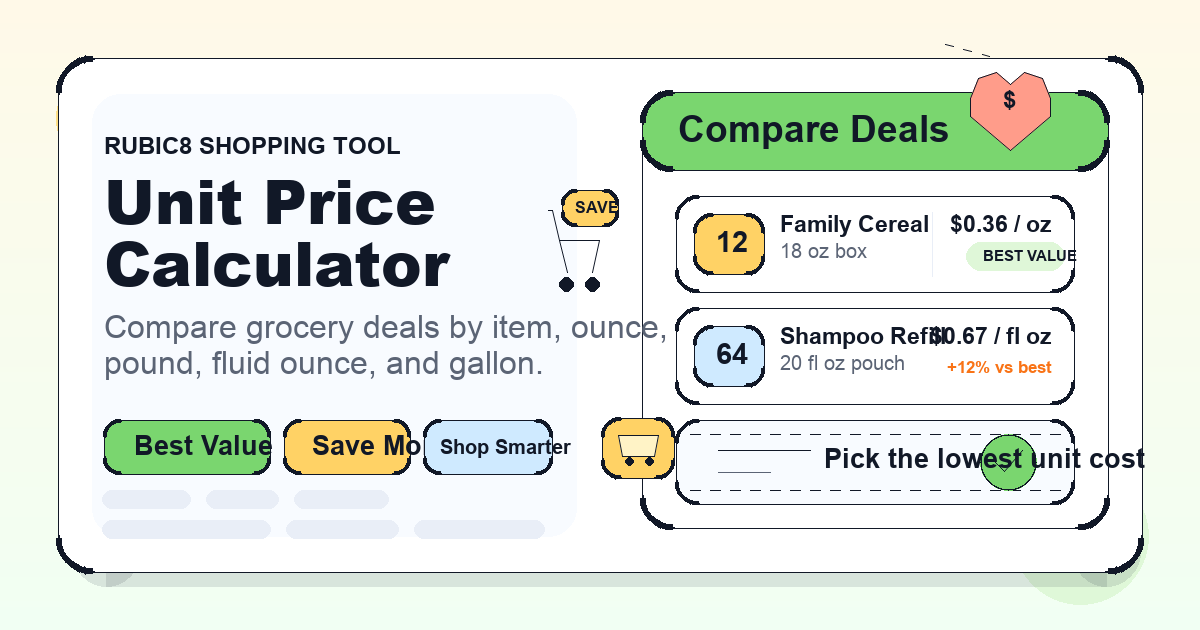
A lower shelf price does not always mean a better deal.
When two products come in different package sizes, counts, or sale formats, it becomes surprisingly hard to tell which one actually gives you more for your money. One box may cost less but contain fewer sheets. One bottle may look more expensive but have a much lower price per fluid ounce. A family pack may sound like a bargain, but only if the unit price is actually better.
That is exactly why a Unit Price Calculator is so useful.
Instead of comparing only the total price, this tool helps shoppers compare the real cost per usable unit, such as:
- per item
- per ounce
- per pound
- per fluid ounce
- per gallon
That makes it much easier to compare groceries, toiletries, household products, drinks, snacks, and everyday essentials.
What Is a Unit Price Calculator?
A Unit Price Calculator is a tool that converts products to the same measurement standard so you can compare them fairly.
For example, imagine one tissue box costs $2.99 and contains 160 sheets, while another costs $3.79 and contains 220 sheets. The first box looks cheaper at first because the total price is lower. But once you compare the cost per sheet, the second box may actually be the better value.
That is the purpose of the tool:
to help shoppers compare value, not just sticker price.
Why Unit Price Matters
Retail pricing is often designed for quick browsing, not for clear comparison. Stores sell similar products in many different ways:
- different package weights
- different liquid volumes
- different item counts
- multi-pack offers
- percent-off promotions
- fixed-dollar discounts
Without a proper comparison, shoppers often choose the wrong option simply because the total price looks lower.
A Unit Price Calculator helps you:
- compare similar products fairly
- identify the best-value deal faster
- evaluate bundle offers accurately
- understand how much more you are paying for weaker deals
- shop smarter in stores and online
How to Use a Unit Price Calculator
This tool usually includes three comparison modes.
1. Compare by Count
Use this when the product is sold by number of pieces.
Examples:
- tissues
- eggs
- detergent pods
- cans
- paper towel rolls
- wipes
- batteries
2. Compare by Weight
Use this when the product is sold by weight.
Examples:
- rice
- cereal
- oats
- flour
- coffee
- pet food
- snack bags
3. Compare by Volume
Use this when the product is sold as a liquid.
Examples:
- shampoo
- body wash
- milk
- juice
- soda
- dish soap
- laundry detergent
Step-by-Step Guide
Step 1: Choose the comparison mode
Pick By Count, By Weight, or By Volume based on the type of product.
Step 2: Enter your currency
For U.S. shoppers, this will usually be $ or USD.
Step 3: Add a count unit label if needed
If you use Count mode, you can enter a label like:
- sheet
- egg
- roll
- pod
- can
- bottle
This makes the result easier to read. Instead of showing cost per 1 item, the calculator can show cost per 1 sheet or cost per 1 egg.
Step 4: Enter product details
For each product, fill in:
- product name
- total price paid
- amount per pack or items per pack
- number of packs in the offer
- discount type
- discount value
Step 5: Compare the deals
The calculator will show:
- the best-value product
- the unit price
- the price gap between products
- the extra cost versus the best option
Real-World Examples Using Common U.S. Units
Example 1: Tissues by Count
This is one of the easiest ways to use Count mode.
- Box A: $2.99 for 160 sheets
- Box B: $3.79 for 220 sheets
How to enter it:
- Compare by: By Count
- Count unit label: sheet
Results:
- Box A = about $0.0187 per sheet
- Box B = about $0.0172 per sheet
Conclusion:
Box B is the better deal, even though its total price is higher.
Example 2: Cereal by Weight
Cereal is best compared by weight.
- Box A: $4.99 for 12 oz
- Box B: $6.49 for 18 oz
How to enter it:
- Compare by: By Weight
Results:
- Box A = about $0.42 per ounce
- Box B = about $0.36 per ounce
Conclusion:
Box B gives better value per ounce.
Example 3: Ground Coffee by Weight
Coffee is another product where the larger bag is not always more expensive per ounce.
- Bag A: $8.99 for 10 oz
- Bag B: $13.99 for 16 oz
Use By Weight.
Results:
- Bag A = about $0.90 per ounce
- Bag B = about $0.87 per ounce
Conclusion:
Bag B is slightly cheaper per ounce, even though the total price is much higher.
Example 4: Shampoo by Volume
Shampoo should be compared by fluid ounces.
- Bottle A: $8.99 for 12 fl oz
- Bottle B: $13.49 for 20 fl oz
Use By Volume.
Results:
- Bottle A = about $0.75 per fluid ounce
- Bottle B = about $0.67 per fluid ounce
Conclusion:
Bottle B is the better value per fluid ounce.
Example 5: Soda Multipack by Volume
Multipacks are where unit pricing becomes especially important.
- Pack A: $7.99 for 12 cans, each 12 fl oz
- Pack B: $2.49 for 2-liter bottle
To compare fairly, convert the bottle by volume and compare the total liquid amount.
Use By Volume.
Pack A:
- total volume = 144 fl oz
Pack B:
- 2 liters is about 67.6 fl oz
Results:
- Pack A = about $0.055 per fluid ounce
- Bottle B = about $0.037 per fluid ounce
Conclusion:
The 2-liter bottle is the better value per fluid ounce, even though many shoppers assume the can pack is better.
Example 6: Milk by Gallon vs Half Gallon
Milk is a classic unit-price comparison.
- Jug A: $4.69 for 1 gallon
- Jug B: $2.79 for 1/2 gallon
Use By Volume.
Results:
- Jug A = $4.69 per gallon
- Jug B = $5.58 per gallon
Conclusion:
The full gallon is the better deal.
Example 7: Laundry Pods by Count
Count mode is perfect for laundry pods.
- Tub A: $14.99 for 42 pods
- Tub B: $19.99 for 76 pods
Use By Count.
Count unit label: pod
Results:
- Tub A = about $0.36 per pod
- Tub B = about $0.26 per pod
Conclusion:
Tub B gives much better value per pod.
Example 8: Paper Towels by Roll
Paper towels often look confusing because the number of sheets and roll sizes vary.
- Pack A: $10.99 for 6 rolls
- Pack B: $16.49 for 12 rolls
Use By Count.
Count unit label: roll
Results:
- Pack A = about $1.83 per roll
- Pack B = about $1.37 per roll
Conclusion:
Pack B is the better deal per roll.
If sheet counts differ a lot between brands, you can go even further and compare by sheet instead of by roll.
Example 9: Snack Bags with a Percent Discount
Discount fields are helpful when you want to compare original price deals correctly.
- Product A: $5.49 for 14 oz, 20% off
- Product B: $4.79 for 11 oz, no discount
Use By Weight.
Results:
- Product A final price = $4.39
- Product A = about $0.31 per ounce
- Product B = about $0.44 per ounce
Conclusion:
After the discount, Product A becomes the much better value.
Example 10: Dish Soap with a Fixed Dollar Discount
Some stores use direct dollar-off promotions.
- Product A: $6.99 for 24 fl oz, $1.50 off
- Product B: $4.99 for 16 fl oz
Use By Volume.
Results:
- Product A final price = $5.49
- Product A = about $0.23 per fluid ounce
- Product B = about $0.31 per fluid ounce
Conclusion:
Product A is the better deal once the fixed discount is applied.
Which Mode Should You Use?
Use By Count when what matters most is the number of usable pieces.
Use By Weight when the product is sold in ounces or pounds.
Use By Volume when the product is sold in fluid ounces, quarts, or gallons.
If a product is tricky, compare it in more than one way. For example, tissues can be compared by sheet count first, then by weight if the thickness seems very different.
Common Mistakes to Avoid
Many shoppers make the same pricing mistakes:
- entering an already-discounted price and then applying the discount again
- forgetting to include the number of packs in a bundle
- comparing different product categories as if they were equal
- focusing only on the total shelf price
- assuming the larger package is always cheaper per unit
A Unit Price Calculator helps avoid those mistakes by making the comparison clear.
Why This Tool Is Great for U.S. Shoppers
In the U.S., shoppers often compare products using:
- ounces
- pounds
- fluid ounces
- gallons
- counts per pack
That makes unit pricing especially important, because two packages can look similar while using completely different size labels.
This tool is especially useful when buying:
- groceries
- warehouse club bundles
- household cleaning supplies
- toiletries
- baby products
- pantry staples
- drinks and bulk packs
Final Thoughts
A Unit Price Calculator is one of the most practical shopping tools you can use. It helps you move beyond shelf price and focus on the number that actually matters: the real cost per ounce, per fluid ounce, per pound, per gallon, or per item.
Instead of asking, “Which one is cheaper?” ask the better question:
Which one gives me more for my money?
That simple shift leads to smarter shopping, better value, and fewer buying mistakes.
FAQ
What does a Unit Price Calculator do?
It compares products fairly by converting them to the same measurement standard, such as per item, per ounce, per pound, per fluid ounce, or per gallon.
What units do Americans usually use for this kind of comparison?
Most U.S. shoppers compare products using item count, ounces, pounds, fluid ounces, and gallons.
When should I use Count mode?
Use Count mode for things like tissues, eggs, pods, wipes, rolls, cans, and batteries.
When should I use Weight mode?
Use Weight mode for products sold in ounces or pounds, such as cereal, rice, coffee, snacks, flour, and pet food.
When should I use Volume mode?
Use Volume mode for liquids like shampoo, milk, soda, juice, detergent, and dish soap.
Can I compare bundle offers?
Yes. Just enter the amount in one pack and the number of packs included in the offer.
Should I use the discount field if I already typed the sale price?
No. Only use the discount field if you entered the original shelf price.
Is the lowest shelf price always the best deal?
No. The lowest total price is not always the lowest unit price. That is why unit-price comparison matters.
