
Google's New AI Content Guidance: A Practical Pre-Publish Checklist for 2026
How to use generative AI for content without sacrificing accuracy, originality, trust, or long-term search visibility
Google updated its guidance on generative AI content on October 1, 2026, adding information from its Search Quality Rater Guidelines. For publishers, the message is not that AI-generated content is automatically bad for Search. The more important question is whether the finished content is accurate, original, useful, trustworthy, and created primarily to help people.
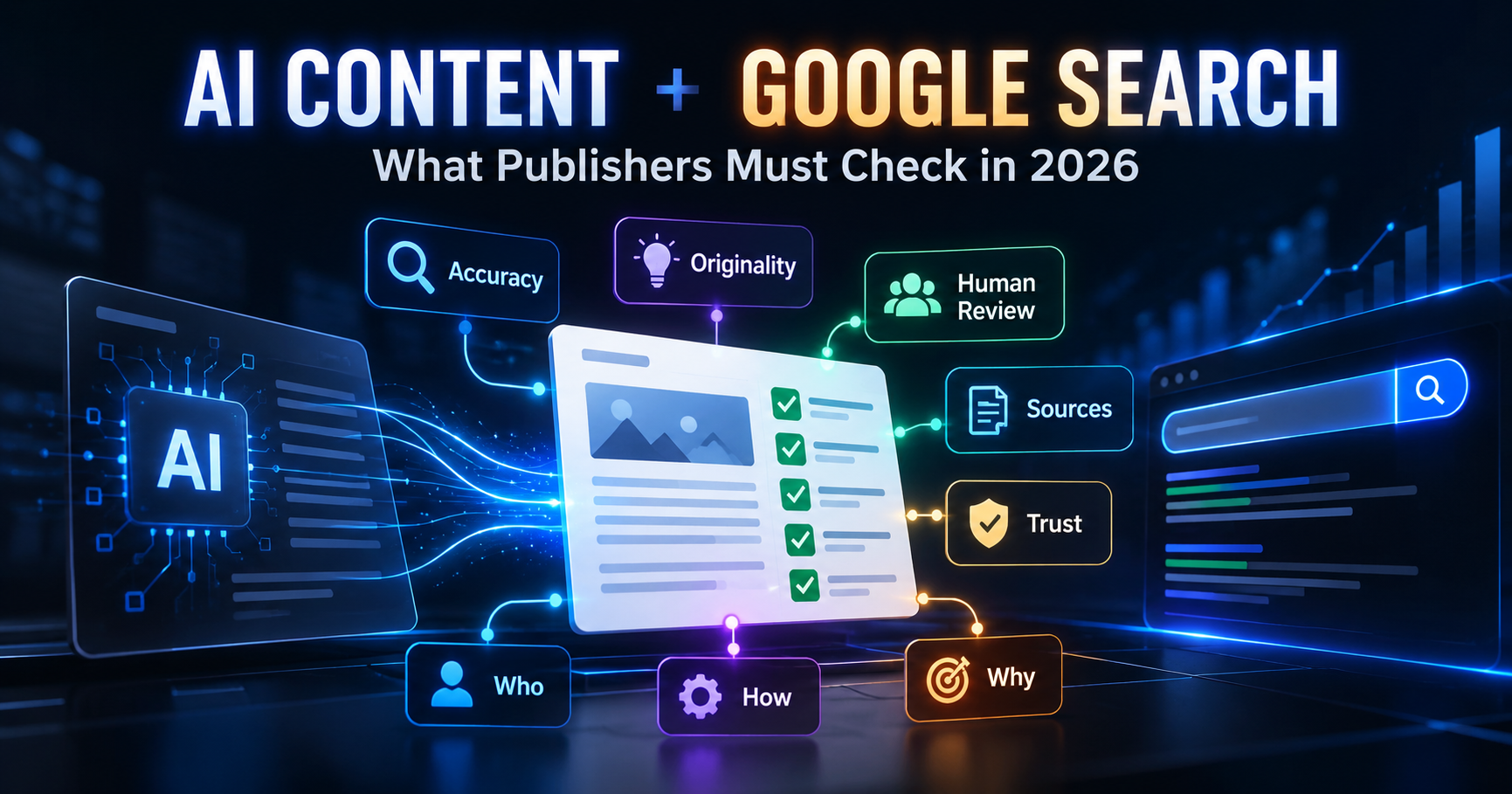
Generative AI has made publishing faster than ever. A writer can research a topic, create an outline, draft thousands of words, rewrite sections, generate metadata, analyze data, and prepare an article for publication in a fraction of the time that the same workflow once required.
But faster publishing creates an important question:
Who is responsible when AI-generated content is inaccurate, outdated, unoriginal, or misleading?
On October 1, 2026, Google Search Central recorded an update to its guidance on using generative AI content. Google said it added information from the Search Quality Rater Guidelines to bring its public documentation in line with material presented at developer events.
For publishers, developers, SEO professionals, and anyone using AI to create web content, the practical takeaway is straightforward:
AI can help create content, but automation does not remove the publisher's responsibility for quality, originality, accuracy, and usefulness.
This guide explains what Google's updated guidance means in practice and provides a 15-point pre-publish audit that publishers can use before putting AI-assisted content live.
Did Google Ban AI-Generated Content?
No. Google does not have a blanket ban on AI-generated content.
Google's guidance focuses much more on why content exists, how it was produced, and what value it provides than on whether a human manually typed every sentence.
Google explicitly discusses automation and AI within its guidance for creating helpful, reliable, people-first content.
The important distinction is between using AI as a production tool and using automation primarily to manipulate search rankings.
Google's spam policies define scaled content abuse as generating many pages primarily to manipulate search rankings rather than help users. Google specifically lists using generative AI or other tools to create many pages without adding value for users as one possible example.
That means these two workflows are not equivalent.
AI-Assisted Editorial Workflow
- Identify a genuine user problem.
- Research the topic.
- Collect reliable primary sources.
- Use AI to assist with analysis, outlining, or drafting.
- Verify factual claims.
- Add original examples, experience, data, code, or tools.
- Edit the content for accuracy and clarity.
- Perform SEO and technical QA.
- Require final editorial approval.
- Publish and monitor performance.
Low-Value Scaled Publishing Workflow
- Collect thousands of keywords.
- Automatically generate thousands of articles.
- Perform little or no meaningful review.
- Automatically publish everything.
- Rely primarily on search traffic.
Both workflows may use generative AI.
But their purpose, editorial process, and resulting value can be completely different.
What Changed in Google's October 2026 Guidance?
Google's Search documentation changelog records an update on October 1, 2026 titled Updated guidance on using generative AI content.
Google says it added information from the Search Quality Rater Guidelines to align the documentation with material used at developer events.
The current people-first content guidance highlights several concepts that are particularly useful when evaluating AI-assisted content.
1. Effort
How much meaningful work went into producing the page?
Effort does not simply mean the number of hours someone spent typing. Useful effort can include original research, testing, analysis, fact-checking, data collection, programming, photography, editing, or building an interactive tool.
For example, an article explaining API pricing becomes considerably more useful when the publisher verifies current prices, tests real API calls, calculates practical examples, and provides a working cost calculator.
By contrast, generating hundreds of similar pages and publishing them without meaningful review requires very little editorial effort even if the resulting word count is enormous.
2. Originality
Does the page provide information, analysis, experience, or functionality that is not simply a repetition of material already available elsewhere?
Generative AI makes it extremely easy to summarize existing information. That makes originality more valuable, not less.
Original value can come from:
- first-hand experience;
- original testing;
- unique data;
- screenshots;
- working code;
- calculations;
- case studies;
- expert analysis;
- interactive tools;
- or a genuinely useful synthesis of complex information.
3. Talent or Skill
Does the finished content demonstrate the level of skill required to satisfy the user's need?
A developer tutorial, for example, should contain technically correct instructions and code that works.
An image optimization guide should understand modern formats, dimensions, compression, responsive images, and browser behavior.
AI can assist an expert, but polished language alone does not demonstrate technical competence.
4. Accuracy
For informational content, factual accuracy matters.
This becomes especially important for topics that change rapidly, such as:
- AI models;
- API pricing;
- software versions;
- Google Search features;
- product specifications;
- regulations;
- security;
- health;
- finance;
- and legal information.
An AI-generated article can sound authoritative while containing incorrect dates, invented features, outdated prices, or nonexistent sources.
Fluent writing is not evidence of factual accuracy.
The Who, How, and Why Framework
Google encourages publishers to think about content through three useful questions:
- Who created the content?
- How was the content created?
- Why was the content created?
This framework becomes especially useful when generative AI is involved.
Who Created the Content?
Readers should be able to understand who is responsible for information when authorship matters.
Depending on the website, this might be:
- an individual author;
- an editorial team;
- an organization;
- a developer;
- a subject-matter expert;
- or another clearly identified publisher.
This does not mean every utility page needs to be written by a famous expert.
It means authorship should not be intentionally ambiguous when knowing who created the information would help users evaluate it.
Clear authorship can also help establish meaningful entity relationships between:
Author → Content → Organization → Topic
This connects naturally with Entity SEO and E-E-A-T: trust is easier to establish when users and search systems can understand who created content, who publishes it, and how those entities relate to a topic.
How Was the Content Created?
For some types of content, readers may reasonably want to know how something was produced.
Google's guidance suggests considering explanations about automation or AI when users might naturally wonder how the content was created.
This does not mean every AI-assisted article needs a large warning label.
Instead, transparency should make sense for the content and its context.
For example, an automated data page might explain:
Data is collected automatically every 24 hours and reviewed for anomalies before publication.
A benchmark article could explain:
Tests were performed using the API version, model, parameters, and methodology documented below.
Transparency is useful when it helps readers evaluate reliability.
Why Was the Content Created?
This may be the most important question.
Was the page primarily created to help someone solve a problem?
Or was it created simply because a keyword appeared in an SEO tool?
Keyword research itself is not the problem. Search intent can be extremely useful because it helps publishers understand what people need.
The problem begins when the strategy becomes:
There are 5,000 keywords, therefore we need 5,000 pages.
without asking whether those pages provide enough distinct value to deserve to exist.
AI-Assisted Content vs. Scaled Content Abuse
This distinction is important because discussions about AI and SEO often mix two very different concepts.
AI-Assisted Publishing
A legitimate publishing workflow may use generative AI for:
- brainstorming;
- research assistance;
- outlining;
- drafting;
- coding;
- translation;
- grammar correction;
- summarization;
- metadata suggestions;
- data analysis;
- and image ideation.
A responsible editorial process then verifies and improves the finished result.
Scaled Content Abuse
Google defines scaled content abuse around purpose and value, not simply the technology used to produce the content.
Examples may include:
- using generative AI to produce many pages without adding meaningful value;
- scraping content from other websites and automatically transforming it;
- combining information from multiple sources without meaningful additional value;
- creating large numbers of nearly identical pages targeting keyword variations;
- or generating pages primarily to manipulate search rankings rather than help users.
Therefore:
AI-generated content is not automatically spam.
But:
Mass-produced, low-value content created primarily to manipulate Search can violate Google's spam policies, regardless of whether it was produced by AI, humans, or a combination of both.
Why AI Hallucinations Are a Publishing and SEO Problem
Generative AI systems can produce statements that sound completely credible while being wrong.
For publishers, this creates a serious verification problem.
An AI system may invent or misstate:
- statistics;
- research papers;
- quotes;
- URLs;
- API methods;
- software versions;
- product features;
- dates;
- prices;
- company announcements;
- or benchmark results.
The surrounding prose may still sound excellent.
Imagine publishing the following statement:
Model X costs $0.50 per million output tokens.
If the current official price is actually $5, the article may still be beautifully written, but the information is wrong.
The same problem becomes much more serious when incorrect information concerns health, finance, legal matters, security, or safety.
Never use confidence of language as a substitute for verification.
15-Point AI Content Pre-Publish Checklist
The following checklist is not an official Google checklist. It is a practical editorial framework based on the quality and spam-policy principles discussed above.
Use it before publishing important AI-assisted content.
1. Verify Every Important Factual Claim
Identify statements that can objectively be true or false.
Pay particular attention to:
- dates;
- prices;
- specifications;
- product availability;
- company announcements;
- statistics;
- technical capabilities;
- and regulatory requirements.
Do not assume a statement is correct simply because the AI expresses it confidently.
2. Verify Dates and Freshness
Information can become outdated extremely quickly.
This is particularly important for:
- AI models;
- APIs;
- software releases;
- prices;
- Google Search features;
- regulations;
- and product availability.
For fast-moving subjects, verify critical information again immediately before publication.
3. Prefer Primary Sources
Whenever practical, verify important claims against the organization responsible for the information.
For example:
- OpenAI model pricing → OpenAI documentation
- Google Search update → Google Search Central
- Cloudflare feature → Cloudflare documentation
- GitHub feature → GitHub documentation
Secondary reporting can provide useful context, but primary documentation is generally the best place to verify product facts.
4. Check Every Citation
Never assume an AI-generated citation exists or supports the claim attached to it.
Open important sources and check that:
- the URL works;
- the source actually contains the relevant information;
- the publication or update date makes sense;
- the source is authoritative enough for the claim;
- and the source supports what the article says.
A real URL that does not support the sentence is still a bad citation.
5. Verify Numbers and Statistics
Numbers deserve additional scrutiny.
Check:
- percentages;
- prices;
- token limits;
- benchmark results;
- market-share figures;
- traffic statistics;
- performance improvements;
- and survey results.
If you cannot find the original or a reliable source, consider removing the number rather than repeating an unverified statistic.
6. Verify Product and API Specifications
Developer content becomes outdated particularly quickly.
Before publishing an API tutorial, verify:
- current model names;
- API endpoints;
- parameters;
- SDK versions;
- context limits;
- pricing;
- deprecated features;
- and supported tools.
Test code examples whenever practical.
7. Ask: What Is Original Here?
This is one of the most useful questions to ask before publication.
Imagine removing your website's name and logo.
Could the same article appear almost unchanged on hundreds of other websites?
If the answer is yes, the page probably needs more original value.
Useful additions can include:
- original testing;
- screenshots;
- working code;
- experiments;
- data;
- calculations;
- first-hand experience;
- comparison methodology;
- interactive tools;
- or a unique workflow.
Originality does not require discovering something nobody has ever known.
It means giving readers a meaningful reason to choose your page.
8. Remove Commodity Paragraphs
Generative AI makes generic explanations extremely inexpensive to produce.
Consider a paragraph such as:
SEO stands for Search Engine Optimization and is the process of improving website visibility in search engines.
The statement is not necessarily wrong.
But millions of similar definitions already exist.
Ask whether generic sections genuinely help the reader. If not, shorten them and spend more space on information that provides distinctive value.
9. Check Search Intent Manually
Keywords are not users.
Before publishing, ask:
What problem is the person searching this phrase actually trying to solve?
For example, someone searching for OpenAI API pricing may need more than a description of pricing.
They may actually be trying to answer:
How much will 20,000 API requests per day cost my application?
An article can explain pricing.
A calculator can solve the problem.
That difference is important when deciding what kind of page to build.
10. Check Authorship and Accountability
Can readers understand who is responsible for the content?
Review:
- author name;
- author profile;
- organization information;
- About page;
- editorial information;
- and contact information where appropriate.
For specialist topics, describe relevant expertise when it genuinely exists.
Do not manufacture credentials merely to create E-E-A-T signals.
11. Audit Internal Links
Internal links should help readers continue their task or understand a related concept.
A useful content relationship might look like:
AI Content Guidelines → Entity SEO & E-E-A-T → AI Search Optimization → Relevant Web Tool
Avoid adding links simply to hit an arbitrary SEO target.
Each internal link should have a logical reason to exist.
12. Verify External Links
Before publishing:
- open important external links;
- check the destination;
- make sure HTTPS works;
- check for unexpected redirects;
- confirm that the page still supports your claim;
- and remove broken or obsolete sources.
For rapidly changing AI and developer topics, current official documentation is usually preferable to an old third-party article.
13. Validate Structured Data
Structured data should describe what actually exists on the page.
For an article, relevant properties may include:
- headline;
- author;
- publisher;
- datePublished;
- dateModified;
- image;
- and the canonical page entity.
But structured data is not a substitute for content quality.
Do not invent authors, reviews, ratings, credentials, or other entities simply to produce richer schema.
14. Check for Scaled-Content Patterns
Do not evaluate only the individual article. Look across the website.
Ask:
- Are hundreds of pages nearly identical?
- Are only city, product, or keyword names changing?
- Are articles mostly rewritten versions of existing pages?
- Are pages being generated faster than they can reasonably be reviewed?
- Do the pages exist because users need them or simply because keywords exist?
Google's scaled content abuse policy can apply regardless of whether the content was produced by humans, generative AI, automation, or a combination of methods.
15. Require Final Human Editorial Approval
This is one of the simplest controls and one of the most useful.
Before publication, a responsible person should be able to answer:
Would I be comfortable putting my name or brand behind this page?
If the answer is no, the content is not ready to publish.
AI can produce drafts extremely quickly.
That makes the final editorial gate more important, not less.
A Practical AI Publishing Workflow for 2026
A sustainable AI-assisted publishing process can look like this:
- Identify a genuine user problem.
- Research the topic.
- Gather primary sources.
- Use AI to assist with analysis, research organization, or outlining.
- Create the first draft.
- Add original examples, experience, data, screenshots, code, or tools.
- Verify factual claims.
- Verify sources and citations.
- Perform human editorial review.
- Optimize for SEO, GEO, and AEO where appropriate.
- Perform technical QA.
- Require final approval.
- Publish.
- Measure performance and update when necessary.
Notice what is missing:
Keyword → Generate → Auto-publish
The difference is editorial responsibility.
What Does This Mean for GEO and AI Search?
The same quality principles are relevant beyond traditional blue-link SEO.
Google's spam policies also apply to Google's generative AI search experiences.
That means publishers should be cautious about treating Generative Engine Optimization (GEO) as another collection of shortcuts designed to manipulate AI-generated answers.
If you want content to be useful in AI-driven discovery systems, focus on making important information:
- clear;
- factual;
- attributable;
- well structured;
- current;
- original;
- and understandable without losing essential context.
Use descriptive headings. Answer important questions directly. Define entities clearly. Cite reliable sources where appropriate. Keep important facts current.
But do not assume that adding dozens of AI-oriented phrases or unnecessary structured-data properties can compensate for weak information.
Should You Disclose AI-Generated Content?
There is no useful universal rule saying that every AI-assisted sentence requires a disclosure.
Google's guidance is more contextual.
A useful question is:
Would knowing how this content was produced help the reader evaluate it?
Disclosure may be particularly useful for:
- AI-generated images;
- synthetic media;
- automated datasets;
- automated summaries;
- benchmark methodologies;
- and large-scale generated resources.
Transparency should improve understanding rather than become a meaningless badge attached to every page.
Does Google Have an AI Content or E-E-A-T Score?
Google does not provide publishers with a public numerical AI Content Quality Score or E-E-A-T score.
Third-party SEO tools can create their own diagnostic scores, but those numbers should not be represented as official Google metrics.
For example, a tool might legitimately create its own score based on a documented methodology.
But it should not claim:
Google E-E-A-T Score: 87/100
as though Google had calculated that number.
A more useful content-audit tool could instead report concrete findings such as:
- 12 factual claims may require verification;
- 3 statistics have no visible source;
- 2 external links are broken;
- author information was not detected;
- 5 sections contain highly repetitive wording;
- publication date was detected;
- Article structured data was detected;
- human editorial review is recommended.
Those findings are actionable.
A mysterious score is much less useful unless its methodology is clearly explained.
Why Useful Tools Matter More in the AI Era
Generative AI is extremely good at explaining information.
That changes the economics of generic informational content.
An AI assistant can quickly explain:
- what an IP address is;
- what JSON is;
- what robots.txt does;
- what a meta description is;
- or how image resizing works.
But explanation and utility are not always the same thing.
Consider this question:
What is JSON?
An AI assistant can answer it immediately.
Now consider this task:
Can you format and validate this 20,000-line JSON document?
That is not merely an informational question. It is a task.
A functioning web tool can provide immediate utility.
For example, Rubic8's JSON Formatter can help users format and inspect JSON directly rather than only explaining what JSON means.
The same principle applies to images. An article can explain image dimensions and optimization, while the Image Resizer lets the user actually perform the task.
This suggests a useful principle for publishing in the AI era:
Content explains. Tools solve.
The strongest web properties can do both.
A Better Model for AI-Era Publishing
A traditional content model often looks like:
Keyword → Article → Search Traffic → Ads
A more durable model can look like:
User Problem → High-Quality Guide → Useful Tool → Supporting Content → Trust → Returning Users
This model is harder to scale instantly.
But that is partly the advantage.
If a useful web asset requires engineering, testing, reliable data, original analysis, or genuine experience, it is harder for thousands of competitors to reproduce overnight using the same prompt.
Practical Example: From AI Article to Useful Web Asset
Suppose a publisher discovers growing interest in API costs.
The easiest strategy is to publish:
How Much Does an AI API Cost?
The article might explain input tokens, output tokens, cached input, and model pricing.
That can be useful.
But the user's actual problem may be:
What will my application cost per month?
A stronger resource could combine:
- a clear pricing guide;
- current official prices;
- real cost examples;
- a model comparison;
- and an interactive API cost calculator.
The article answers the question.
The calculator completes the task.
That additional utility is much harder to replace with another generic AI-generated article.
AI Content Pre-Publish Quick Checklist
Before publishing an AI-assisted article, use this shorter final review:
- ☐ Important facts have been verified.
- ☐ Dates and prices are current.
- ☐ Important claims use reliable sources.
- ☐ Citations actually support the claims.
- ☐ Statistics have been verified.
- ☐ Product and API specifications are current.
- ☐ The article adds original value.
- ☐ Generic or unnecessary sections have been removed.
- ☐ Search intent has been manually reviewed.
- ☐ Authorship and accountability are clear.
- ☐ Internal links are useful and relevant.
- ☐ External links work.
- ☐ Structured data represents real page content.
- ☐ The page is not part of a low-value scaled-content pattern.
- ☐ A human has given final editorial approval.
Frequently Asked Questions
Does Google penalize AI-generated content?
No blanket rule says content is penalized simply because generative AI was used to create it. Google focuses on the purpose and quality of content and whether it complies with Search spam policies. Using generative AI to create many pages without adding meaningful user value can be an example of scaled content abuse.
Can I use ChatGPT, Gemini, Claude, or other AI tools to write blog posts?
Generative AI can be part of a legitimate publishing workflow. It can assist with research, brainstorming, outlining, drafting, editing, coding, translation, and analysis. The publisher remains responsible for the accuracy and quality of the finished page.
Does AI-generated content require human review?
Google does not prescribe one universal editorial workflow for every AI-assisted page. However, checking important facts, sources, accuracy, originality, and usefulness before publication is a sensible publishing practice, particularly for fast-changing or high-impact topics.
Is mass AI content against Google's policies?
Using AI at scale is not automatically a violation. The important issue is whether pages are being generated primarily to manipulate search rankings while providing little or no additional value to users. That can fall under Google's scaled content abuse policy.
Should AI-generated content include sources?
Not every ordinary statement requires a citation, but important factual claims should be verifiable. For fast-changing topics such as AI models, APIs, pricing, software releases, and Google Search updates, current primary documentation is particularly valuable.
Does Google have an E-E-A-T score?
Google does not provide publishers with a public numerical E-E-A-T score. Third-party tools may create their own metrics, but those should be clearly identified as proprietary diagnostic scores rather than official Google measurements.
Should I disclose that AI was used?
Consider whether knowing how the content was produced would help users evaluate it. Disclosure can be particularly useful for synthetic media, automated datasets, AI-generated images, automated summaries, benchmarks, or other situations where the production method materially affects how readers interpret the content.
Can AI-assisted content appear in Google's AI search experiences?
Using AI during content production does not by itself determine visibility. Google's general Search policies and spam policies remain relevant to its generative AI search experiences. Focus on producing accurate, useful, original, accessible content rather than trying to reverse-engineer a special AI-content formula.
How can I make AI-assisted content more useful than competing articles?
Add something that cannot be produced simply by paraphrasing existing pages. Examples include first-hand experience, original testing, data, screenshots, working code, calculations, comparison methodology, case studies, or interactive tools.
Final Thoughts
The biggest publishing mistake in the generative AI era may not be using AI.
It may be using AI to eliminate the parts of publishing that actually create value.
Research matters.
Verification matters.
Experience matters.
Original analysis matters.
Working tools matter.
Editorial judgment matters.
Accountability still matters.
Google's October 2026 documentation update is useful not because it reveals a secret new AI ranking factor.
It reinforces a much more durable principle:
Use AI to increase your capability, not to remove responsibility from the publishing process.
The ability to generate another 2,000-word article is no longer rare.
Almost anyone can do it.
The competitive advantage increasingly comes from everything that happens around generation:
- choosing the right problem;
- finding reliable evidence;
- verifying claims;
- adding original value;
- building useful functionality;
- and deciding whether the finished page deserves to exist.
That is a much higher standard than simply asking whether Google allows AI content.
It is also a stronger foundation for building a website that remains useful as Search, AI search, and generative AI continue to evolve.
Official Sources
For the latest information, refer directly to Google's documentation:
- Google Search Central: Documentation updates
- Google Search Central: Creating helpful, reliable, people-first content
- Google Search Central: Spam policies for Google web search
Last reviewed: October 2, 2026. Google's Search documentation and policies can change, so publishers should verify current guidance against the official sources above.
Rubic8 Editorial Team
Editorial Team
Rubic8 creates practical guides and free tools for developers, webmasters, and digital publishers. Our fast-changing technical content is reviewed against current primary documentation before publication.
