
PHP 8.6 for Laravel Developers: Features, Compatibility, and a Safer Upgrade Plan
What changed on November 19, 2026—and how to test Composer dependencies, sessions, FPM and queues before moving production.
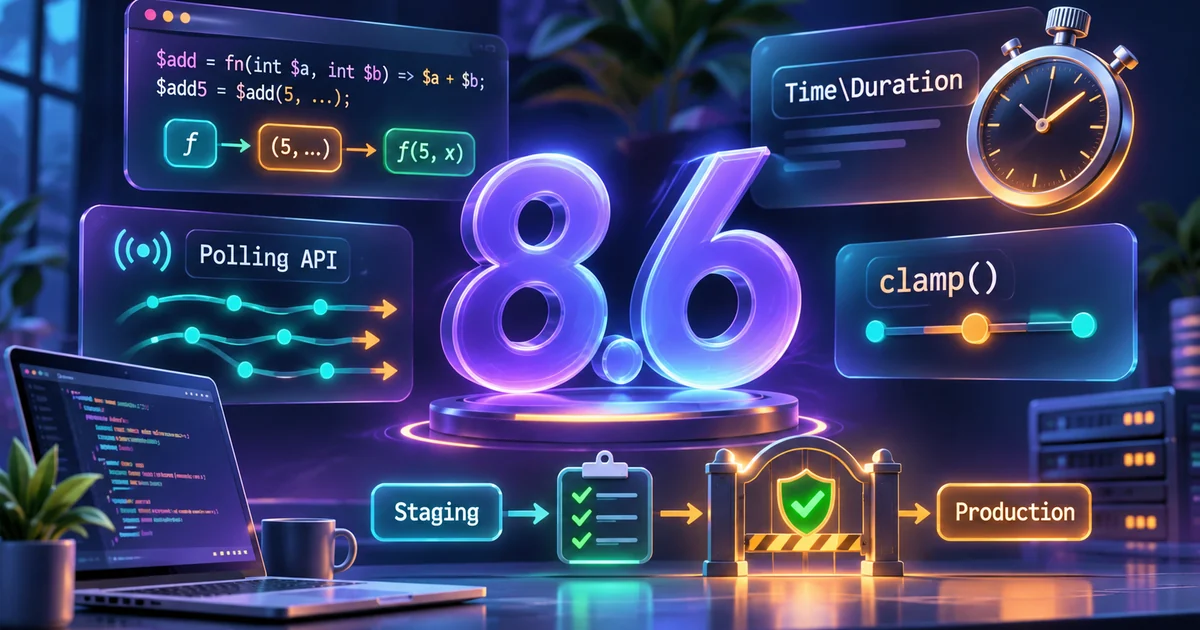
Updated November 23, 2026. PHP 8.6.0 arrived on November 19, introducing partial function application, a native duration type, scalable I/O polling, and a built-in clamp() function. For Laravel teams, however, the headline is only the start of the upgrade decision. Composer dependencies, PHP extensions, queue workers, session behavior, and the specific framework release all determine whether a deployment is safe.
In this guide, we separate what PHP 8.6 adds from what a Laravel application must prove before upgrading. We also show a low-risk staging workflow that works for self-managed VPS hosting, PHP-FPM, Nginx, MySQL or MariaDB, and CI pipelines. The examples are illustrative and require PHP 8.6 where explicitly indicated; they have not been executed against your production project.
PHP 8.6 release: the short version
The official PHP 8.6 announcement confirms the November 19 release and highlights several language and runtime improvements. This is a new language release, not a security patch for an older PHP branch. If you maintain a production application on an existing supported branch, keep applying its security updates while evaluating 8.6 separately.
The main changes are easier to understand when grouped by the problem they solve, rather than by their novelty:
- Cleaner functional composition: partial function application pre-fills parameters and returns a closure for the remaining arguments.
- Explicit elapsed time:
Time\Durationmodels a measured time span rather than a calendar interval. - Scalable stream readiness: the new
Io\PollAPI is designed for I/O event loops. - Smaller utility helpers:
clamp()constrains a value within bounds;SortDirectionprovides a common type-safe ordering vocabulary. - Compatibility changes: session defaults, error behavior, and certain library-facing details can change existing application behavior.
Use the official migration overview as the authoritative checklist. A feature working in a small script is not the same as a Laravel application being tested and supported across its complete dependency graph.
Partial function application: cleaner callbacks in PHP 8.6
Historically, writing a reusable callback that fixes some arguments has often meant creating a small anonymous function. PHP 8.6 introduces partial function application, in which ? marks a parameter that will be supplied when the returned closure is invoked. The PHP manual documents the syntax and its limitations.
A before-and-after example
// Before PHP 8.6: write a wrapper callback.
$normalize = fn (string $value): string =>
    str_replace(' ', '-', strtolower(trim($value)));

// PHP 8.6: pre-fill arguments and leave the input open.
$replaceSpaces = str_replace(' ', '-', ?);
echo $replaceSpaces('Laravel upgrade plan');
// Laravel-upgrade-plan
For Laravel developers, this can simplify tiny transformations in collection operations, service configuration, or pipeline code. But it should not become a reason to refactor dozens of stable callbacks on upgrade day. Use it where readability actually improves; remember that syntax requiring 8.6 will prevent the same file from being parsed by an older runtime.
Where partial application does not help
A named helper function may still be clearer when validation rules, logging, multiple branches, or business meaning are involved. Do not convert security-sensitive payment logic into densely chained one-liners. If the team runs mixed versions of PHP while rolling out code, schedule language-syntax adoption only after all active web and worker processes have moved to a compatible runtime.
Time\Duration: elapsed time without calendar ambiguity
The new Time\Duration class represents an elapsed, stopwatch-like amount of time. That is different from a DateInterval, which is appropriate for calendar-aware date arithmetic. The official Duration documentation explicitly makes this distinction.
// Available on PHP 8.6+.
$connectTimeout = Time\Duration::fromMilliseconds(250);
$jobBudget = Time\Duration::fromSeconds(30);
Think about request timeouts, an I/O polling wait, or a measured duration reported by a health check. Those are elapsed-time concepts. By contrast, “renew this subscription next month” is a calendar instruction; it cannot always be represented as a fixed number of seconds because month lengths and daylight-saving transitions vary.
Laravel already provides high-level configuration for queue timeouts, retries, scheduler behavior, and HTTP clients. PHP 8.6 does not automatically migrate those APIs to Time\Duration. Use the new class when a library explicitly accepts it or when you control an abstraction that benefits from clear time units.
Io\Poll: why event-loop developers should care
The new polling API provides scalable readiness monitoring for many I/O handles, with operating-system backends such as epoll or kqueue where available. It targets the class of problems that arise when a process must watch many simultaneous streams. It is particularly relevant to event-loop libraries and long-running network services, not an automatic accelerator for every traditional PHP request.
A standard Laravel application served by PHP-FPM spends most of its request lifecycle in framework code, database queries, remote API calls, and business logic. Adding Io\Poll to PHP does not guarantee higher requests per second or lower latency for that workload. Benchmark your own route mix before making performance claims.
What to test in long-running processes
If you use a WebSocket process, a custom streaming consumer, or an async component next to Laravel, confirm the relevant framework or library has adopted and tested the new API. Test high connection counts, shutdown handling, backpressure, timeouts, and failures in staging. A good companion topic is the Rubic8 guide to time awareness and asynchronous tools in API workloads, where timeouts and lifecycle management matter more than a language feature alone.
clamp() and SortDirection: two smaller improvements
PHP 8.6 includes clamp(), a small helper that returns the nearest allowed bound when a value falls outside the requested range. It can make code for pagination limits, UI percentages, or retry parameters easier to read.
// PHP 8.6+
$pageSize = clamp($requestedPageSize, 1, 100);
$progress = clamp($completedPercent, 0, 100);
A clamp is not a substitute for request validation. For security-sensitive or billing-sensitive inputs, it may be correct to reject an invalid value instead of silently changing it. A maximum upload size, monetary amount, or authorization scope deserves its own explicit validation rule.
The new SortDirection enum standardizes a common concept that different libraries previously expressed as booleans, integers, or strings. Existing Eloquent orderBy() calls do not need to be changed merely because the enum exists. Keep application APIs consistent with the framework version actually in use.
The Laravel compatibility question: do not confuse installable with supported
As of this article's review date, the Laravel framework release notes list the officially documented PHP range for Laravel 13 as 8.3–8.5. PHP 8.6 is newer than that published range. The fact that a dependency constraint such as ^8.3 may allow Composer to resolve on 8.6 is not the same as a published compatibility or test guarantee.
This distinction matters for real projects. Your application may install successfully and still encounter issues in an extension, a package with a narrow test matrix, a queue worker, or an older integration. Treat PHP 8.6 as a separate compatibility validation until your framework, packages, and runtime environment are ready.
Check the exact application, not just the framework name
Record your Laravel major/minor version, composer.lock, extensions, cache backend, database driver, queue system, and web-serving mode. A Laravel 10 application on PHP 8.1 is a different migration project from Laravel 13 on PHP 8.5. The former may require a framework upgrade path and package replacements before trying the latest PHP runtime.
Use composer why-not php 8.6.0 and composer check-platform-reqs in an isolated checkout. The first can surface explicit package constraints; the second checks extensions and runtime platform requirements. Neither command certifies full behavioral compatibility.
Backward compatibility: the PHP 8.6 changes to audit first
New syntax is only half the release story. The official backward-incompatible changes page documents changes that can alter application results or trigger exceptions. Prioritize tests around inputs you actually receive, especially authentication, file handling, and legacy utility functions.
Session defaults are more secure but can affect integrations
Several PHP session INI defaults are tightened in 8.6: session.use_strict_mode defaults to 1, session.cookie_httponly to 1, and session.cookie_samesite to Lax. These defaults are welcome for many applications, but cross-site POST flows, custom session handlers, or JavaScript code that reads session cookies can behave differently.
Laravel may configure cookies and sessions through its own configuration, which means the effective behavior depends on both application settings and PHP settings. Test login, password reset, OAuth and third-party redirects, admin authentication, and any cross-origin integration. Check actual response cookies, not only the contents of an INI file.
Invalid arguments may now raise ValueError
Several functions now reject invalid flags, modes, out-of-range numbers, or NUL bytes with ValueError rather than silently accepting, truncating, or warning about them. Examples in the migration guide include array_filter() with an invalid mode and scandir() with an invalid sorting order.
That is good defensive behavior, but it can change control flow in older code. Put boundary and malformed-input tests around file uploads, report exports, admin parameters, and any dynamic flags passed into built-in functions. A narrow, repeatable regression suite is far more valuable than a generic statement that the framework “works on PHP 8.6.”
Other behavioral changes worth noting
The release also adjusts edge cases around trim() and form-feed characters, magic-property access, array intersection conversion order, and certain file and stream operations. Not every application is affected. Search your code for the APIs you use, read the corresponding migration notes, and add tests only where the behavior has business significance.
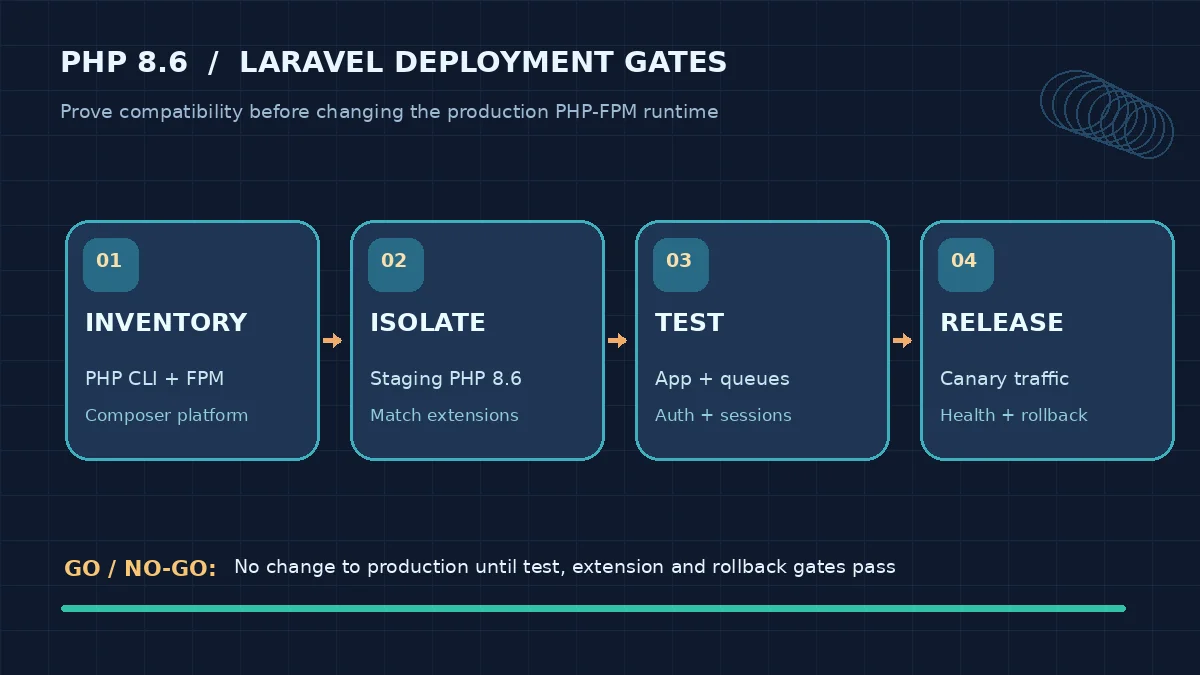
Four-stage PHP 8.6 upgrade plan for a Laravel VPS
Use this sequence when preparing a new PHP runtime. It is deliberately conservative because an incorrect PHP-FPM switch can take down every route using that pool, even when CLI tests looked clean.
Stage 1: inventory and preserve rollback
Take a file and database backup appropriate to your system, and confirm you can restore from them. Record the current deployment commit, PHP-FPM pool configuration, loaded extensions, application secrets location, and process supervisor configuration. Do not put credentials into logs or a Git repository.
php -v
php -m
php -i | grep -E 'session.use_strict_mode|session.cookie_httponly|session.cookie_samesite'
composer validate --no-check-publish
composer check-platform-reqs
Run these on the actual application runtime where possible. CLI PHP and PHP-FPM may use different binaries, INI files, extensions, or pool-level settings. The commands above inspect the current environment; they do not install or switch PHP versions.
Stage 2: build a separate PHP 8.6 staging runtime
Use a disposable container, isolated virtual machine, or separate staging site. Do not replace the system-wide php symlink as an experiment on a shared VPS. Pin your dependency lockfile, install dependencies with the target runtime, and verify extensions such as pdo_mysql, mbstring, intl, zip, curl, and openssl according to your app's needs.
Run migrations only against a staging database clone. A schema migration that changes production data is not made safer merely because the new PHP interpreter passes unit tests. For a GitHub-based staging workflow, the Rubic8 discussion of cloud sandbox costs and controls offers a related operational perspective, though a sandbox is not itself proof of production compatibility.
Stage 3: verify behavior, not only syntax
Start with automated tests and continue with a manual smoke test list covering authentication, webhooks, checkout, email, image processing, reports, scheduled tasks, and queued jobs. Include a specific replay/duplicate-delivery test for webhook consumers; Rubic8's Laravel webhook idempotency guide explains why safe retries must be tested separately from successful HTTP responses.
composer why-not php 8.6.0
composer check-platform-reqs
php artisan test
php artisan route:list
These are illustrative commands to run in staging with the correct dependencies installed. If your test suite is incomplete, write the critical business-path tests first. Compare runtime warnings, query errors, memory usage, exception rates, and queue failure counts against a baseline on the currently supported PHP version.
Stage 4: canary deploy and recover predictably
Move one staging-verified pool or a small slice of traffic first. After deploying code or changing the runtime, reload long-running queue workers and other processes using your supported deployment mechanism. Monitor auth failures, payment callbacks, cache behavior, and unexpected deprecation or ValueError logs. Preserve a rollback route that returns traffic to the previous PHP pool and working deployment.
A rollback plan should name the previous FPM socket/pool, the deployment commit, the backup location, the person authorized to revert, and the symptoms that trigger immediate recovery. Do not assume rolling back PHP automatically reverses database schema changes.
Security patching is a separate decision from PHP 8.6 adoption
A team may reasonably defer adopting new PHP 8.6 language features while still applying the latest security maintenance release on its existing supported branch. PHP 8.6 is not the only path to safer software. The PHP support schedule explains which branches still receive fixes and when support ends.
On legacy applications, the first priority is identifying unsupported runtime versions and constructing an upgrade path that fits the framework's requirements. Avoid using “we cannot move to PHP 8.6 yet” as a reason to ignore patching on the version you are able to run safely today. Equally, do not equate a successful composer install with a production-ready migration.
SEO and developer documentation after a runtime upgrade
If your application publishes developer documentation, changelog posts, or tool pages, make the version context explicit. A PHP 8.6 code example should be labeled PHP 8.6+; a fallback for older runtime versions should be shown when practical. Provide accurate dates, link primary documentation, and avoid invented benchmark improvements.
For configuration snippets stored as JSON or exported settings, validate structure before deployment. Rubic8 provides a JSON Validator for quick inspection of configuration-like payloads. It is a format check, not a replacement for schema validation, secret handling, or running tests.
FAQ: PHP 8.6 and Laravel
Is PHP 8.6 officially released?
Yes. PHP 8.6.0 was released on November 19, 2026. Confirm the precise release and download information on php.net rather than relying on prerelease or beta articles.
Should a production Laravel 13 app switch to PHP 8.6 today?
Not just because 8.6 is available. As of November 23, Laravel's published compatibility table lists 8.3–8.5 for Laravel 13. Check for updated official guidance, then test your complete project in an isolated environment before any production cutover.
Will PHP 8.6 automatically speed up my Laravel site?
No specific speedup is guaranteed. New I/O primitives target particular event-loop workloads. Database performance, caching, PHP-FPM configuration, network calls, and application bottlenecks still dominate many sites. Benchmark real routes using representative data and identical configurations.
Can existing PHP 8.1 code use the new syntax?
No. Syntax such as partial function application requires a PHP 8.6 parser. First plan a supported runtime and Laravel version combination; do not commit 8.6-only syntax while some workers still use older PHP.
Bottom line: adopt deliberately
PHP 8.6 offers practical language improvements, notably partial application and clearer elapsed-time semantics. But the best Laravel upgrade is the one where dependency compatibility, session behavior, test coverage, web and worker runtimes, and a rollback path are all documented. Treat the November 19 release as a good moment to start testing—not permission to flip production to a new interpreter without evidence.
Editorial note: This guide was written from the official PHP release notes, migration and compatibility references available on November 23, 2026. Check upstream documentation again before deploying, because package and framework support can change.
Rubic8 Editorial Team
Editorial Team
Rubic8 creates practical guides and free tools for developers, webmasters, and digital publishers. Our fast-changing technical content is reviewed against current primary documentation before publication.
