
Google Says You Don't Need llms.txt for AI Search — So What Actually Works?
A practical 2026 guide to SEO, GEO, AI Overviews and AI Mode
For months, website owners and SEO professionals have been asking the same question:
Do I need an llms.txt file to make my website visible to ChatGPT, Google AI Mode, AI Overviews and other AI search engines?
For Google, we now have a much clearer answer.
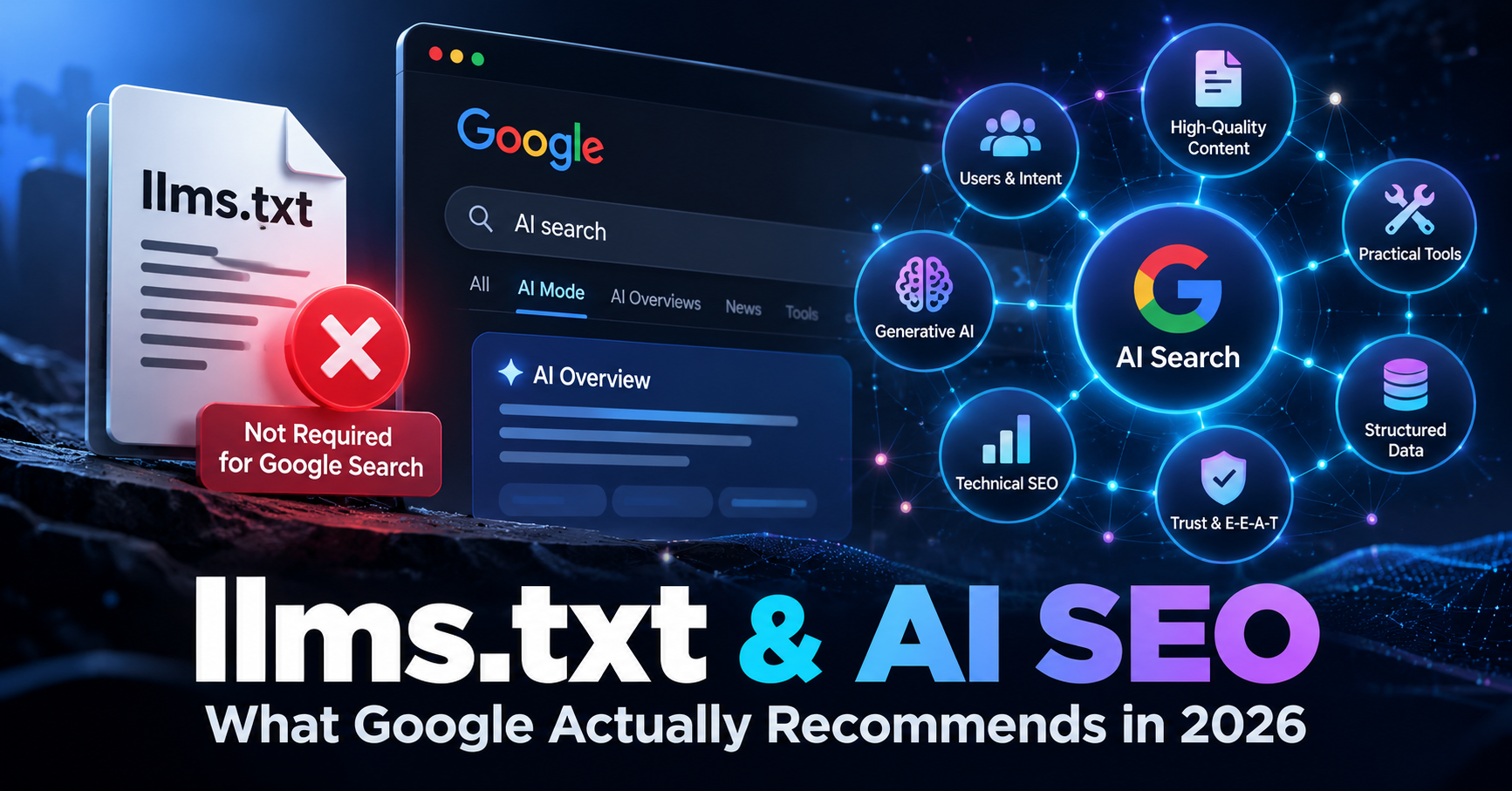
No — you don't need llms.txt to improve your visibility in Google Search.
In June 2026, Google clarified its guidance on llms.txt. According to Google Search documentation, llms.txt files are not required for Google Search and do not positively or negatively affect your visibility or rankings.
That doesn't mean AI search optimization is useless.
It means website owners may be focusing on the wrong thing.
Instead of searching for a new magic file for AI crawlers, Google is pointing publishers back toward something much more fundamental:
Create valuable, accessible, understandable and non-commodity content using solid SEO foundations.
What Is llms.txt?
llms.txt is a proposed text file designed to provide AI systems with structured information about a website and its important content.
The idea is conceptually similar to other machine-readable files used on websites.
A typical URL might look like:
https://example.com/llms.txt
Because AI assistants and generative search systems are becoming important discovery channels, llms.txt quickly attracted attention among developers, publishers and SEO professionals.
The attractive idea was simple:
What if adding one file could make AI systems understand and recommend your website?
Unfortunately, AI search optimization isn't that simple.
Does Google Use llms.txt?
Google says llms.txt isn't needed for Google Search.
In a June 2026 documentation update, Google clarified that maintaining an llms.txt file won't positively or negatively affect a site's Google Search visibility or rankings.
Google also noted that site owners are free to maintain the file for other services or systems that may use it.
This distinction matters.
It doesn't mean:
- llms.txt is universally useless;
- no AI service will ever use it;
- AI search optimization doesn't exist.
It means something much narrower:
You shouldn't expect llms.txt to give your website a ranking or AI visibility advantage in Google Search.
Then How Do You Optimize for Google AI Search?
This is where things become more interesting.
In May 2026, Google published expanded guidance for succeeding in generative AI features in Search.
One of the most important takeaways is that traditional SEO fundamentals still matter.
But there is another idea worth paying attention to:
Non-commodity content.
What Is Non-Commodity Content?
Commodity content is information that thousands of other websites can reproduce with little effort.
For example:
An IP address is a numerical identifier assigned to a device connected to a network.
That information is useful, but it isn't particularly unique.
An AI system can already explain it.
Now imagine a page that:
- detects the visitor's real public IP address;
- identifies IPv4 or IPv6;
- shows ISP information;
- provides approximate location information;
- explains privacy limitations;
- lets the user perform another IP lookup;
- and provides original technical explanations.
That page provides something an ordinary paragraph cannot.
It does something.
This is particularly important for tool websites.
Why Online Tools May Have an Advantage in the AI Era
Generative AI is exceptionally good at generating explanations.
It is less able to replace every interactive utility on the web.
A user may ask an AI:
What is an IP address?
and receive a perfectly good explanation without visiting a website.
But when that user searches:
What is my current IP address?
a live web utility can provide information specific to that user's current connection.
This distinction suggests an important strategy:
Don't compete with AI only by producing more text. Build things AI answers cannot completely replace.
A Practical Example: Rubic8's What Is My IP Tool
Rubic8 already provides a What Is My IP utility.
Instead of treating the tool as an isolated page, it can become the center of an entire knowledge cluster:
- What Is an IP Address?
- IPv4 vs IPv6
- Public IP vs Private IP
- Can Someone Track You From Your IP Address?
- Does a VPN Hide Your IP Address?
- How Accurate Is IP Geolocation?
- How to Find Your IP Address
- Why Does My IP Address Keep Changing?
Users requiring information about another address can then continue to Rubic8's IP Address Lookup tool.
This combination creates something more defensible than dozens of generic AI-generated articles:
Utility + original information + topical depth.
What Actually Matters for AI Search in 2026?
Based on Google's current guidance, here are the areas website owners should prioritize.
1. Make Important Pages Crawlable
If Google cannot crawl and index your content, additional AI optimization tricks aren't going to solve the underlying problem.
Check:
- robots.txt;
- noindex directives;
- canonical URLs;
- internal links;
- XML sitemaps;
- HTTP status codes.
2. Publish Information Worth Finding
Ask a difficult question before publishing:
What does this page provide that users can't already get from hundreds of existing pages or directly from an AI assistant?
Possible answers include:
- an interactive tool;
- original data;
- first-hand testing;
- screenshots;
- experiments;
- benchmarks;
- case studies;
- unique analysis;
- or genuine professional experience.
3. Make Your Content Easy to Understand
Use descriptive headings and answer important questions directly.
For example:
Does llms.txt improve Google rankings?
No. Google says llms.txt doesn't positively or negatively affect Google Search visibility or rankings.
Notice that the answer appears immediately.
This format helps humans and makes the page easier for automated systems to interpret.
4. Establish Clear Entities
Search systems should be able to understand:
- who operates the website;
- who wrote an article;
- what organization publishes it;
- what topics the site covers;
- and how these entities relate to each other.
This is where Entity SEO and E-E-A-T become relevant.
Clear About pages, author profiles, organization information, consistent branding and appropriate structured data can reduce ambiguity.
5. Use Structured Data Correctly
Structured data can help search engines understand information represented on your pages.
Depending on the content, useful Schema.org types may include:
- Organization;
- Person;
- Article;
- WebSite;
- WebPage;
- BreadcrumbList;
- ProfilePage.
But schema isn't an AI ranking hack.
It should describe the real content and entities on the page.
6. Think Beyond Traditional Keywords
Search behavior is becoming more conversational.
Instead of searching only:
ip lookup
people increasingly use questions such as:
Can someone find my location from my IP address?
or:
Why does my IP address change when I restart my router?
This creates opportunities for websites that answer specific real-world questions clearly.
SEO vs AEO vs GEO: Do You Need Three Different Strategies?
Probably not.
The terminology can make modern search optimization appear more complicated than necessary.
| Term | Main Idea |
|---|---|
| SEO | Improve visibility and usefulness in search engines |
| AEO | Make information suitable for answer-oriented experiences |
| GEO | Make content understandable and useful to generative search systems |
There are differences, but they share many foundations.
A well-built page can serve all three.
Should You Delete Your llms.txt File?
Not necessarily.
If you already maintain an llms.txt file, Google's guidance doesn't suggest that having one harms your rankings.
Other systems may choose to use the format.
But don't confuse maintaining the file with an SEO strategy.
Spending hours perfecting llms.txt while your website contains thin pages, unclear authorship, poor internal linking and no original value would be optimizing the least important part of the system.
What I Would Do Instead of Obsessing Over llms.txt
If I had ten hours to improve a small website for AI search, I would spend them roughly in this order:
- Improve the site's most useful tools or pages.
- Add original information and first-hand examples.
- Build supporting topic clusters.
- Improve internal linking.
- Clarify authors and organization identity.
- Check crawlability and indexing.
- Add accurate structured data.
- Improve page experience and mobile usability.
- Update outdated content.
- Then experiment with emerging standards such as llms.txt.
The Bigger Lesson: Stop Looking for an AI SEO Shortcut
Every major change in search creates a new wave of supposed shortcuts.
Meta tags.
Keyword density.
Backlink formulas.
Schema hacks.
And now AI-specific files.
Technical standards matter, but the bigger competitive advantage is usually harder to copy:
Create something genuinely useful.
For a tool website, that may mean a better tool.
For a technical blog, it may mean an original experiment.
For a developer, it may mean code that solves a real problem.
For an expert, it may mean knowledge gained from years of actual experience.
AI makes generic information cheaper.
That makes original utility and experience more valuable — not less.
Frequently Asked Questions
Does Google use llms.txt?
Google says llms.txt isn't needed for Google Search and doesn't positively or negatively affect Search visibility or rankings.
Will llms.txt help my website appear in AI Overviews?
Google doesn't recommend llms.txt as a method for improving visibility in AI Overviews or AI Mode. Standard search best practices and useful, accessible content remain important.
Is GEO replacing SEO?
No. Generative search introduces new discovery experiences, but many core SEO principles — crawlability, useful content, internal linking, clear site structure and good page experience — remain relevant.
Should I create content with AI?
AI can assist research, drafting, coding and editing, but mass-producing unoriginal pages simply to manipulate rankings can violate Google's spam policies. The important question is whether the resulting page provides genuine value to users.
What is the best way to optimize for AI search?
There is no single AI optimization trick. Focus on useful original content, clear entities, crawlability, good site architecture, accurate structured data and information that answers specific user needs.
Final Thoughts
The llms.txt discussion reveals something important about the current state of AI SEO.
Website owners understandably want a technical switch that makes their content visible to AI.
But Google's current guidance points in a different direction.
You don't need a special AI file to succeed in Google Search.
You need pages worth discovering.
Make them crawlable.
Make them understandable.
Make their authors and entities clear.
Provide evidence.
Build useful tools.
Publish information that isn't simply another version of something AI already knows.
That may not sound like a shortcut.
But in an internet increasingly filled with commodity AI content, it may be one of the strongest competitive advantages left.
Rubic8 Editorial Team
Editorial Team
Rubic8 creates practical guides and free tools for developers, webmasters, and digital publishers. Our fast-changing technical content is reviewed against current primary documentation before publication.
